Many years ago, I stumbled upon a documentary that was as fascinating as it was terrible. Fascinating because it greatly influenced my perspective as a photographer, and terrible because it portrayed the life of a bad person.
The documentary is called ‘The Power of Images’ and tells the story of Leni Riefenstahl, a witch.

Probably because of her personality, Leni Riefenstahl did not get along well with ‘narrative’ cinema. It is highly unlikely that she was particularly interested in the feelings of her characters. From that point of view, her films come across as stilted and false, emotionally abstract.
However, it is undeniable that she had a keen eye for photographic motifs. And that talent was expressed in two true masterpieces. Both are “documentaries”. I put this in quotation marks because, despite dealing with events that took place in her time, their aim was not to reflect reality in a neutral way, but to squeeze and compress it into a mold that served the interests of the producers of those films. In this case, the Nazi party.
As anyone who has taken even a passing interest in the subject knows, Leni Riefenstahl made her name with two masterpieces: one clearly sinister and the other in which darkness takes a back seat. Both have been hugely influential in the history of the visual arts, an influence that continues to this day. The first, the most obviously dark, is Triumph of the Will, a seminal piece of propaganda, an ‘idealised’ account of the National Socialist Party congress in Nuremberg.
As Riefenstahl had a virtually inexhaustible budget and unrestricted creative freedom, she could afford to introduce technical innovations that are now standard. These are expressive resources to which we are immune due to television, but which were an unprecedented visual leap forward at the time. For example, close-ups of Hitler giving his speeches, created by placing a circular travelling shot around the dictator. Never before in history had people seen their rulers so closely. Seeing Hitler’s face on the cinema screen, the same size as that of, say, Greta Garbo, made him seem unreal, mythical and superhuman.
The next step in Riefenstahl’s career was the titanic undertaking of filming the 1936 Olympic Games in Berlin.
From a photographic point of view, the most interesting thing is to understand how Leni Riefenstahl approached the creative problems inherent in her craft. She realised from the outset that photographing sports is, above all, photographing highly repetitive movements and, therefore, very difficult to turn into an interesting visual object.
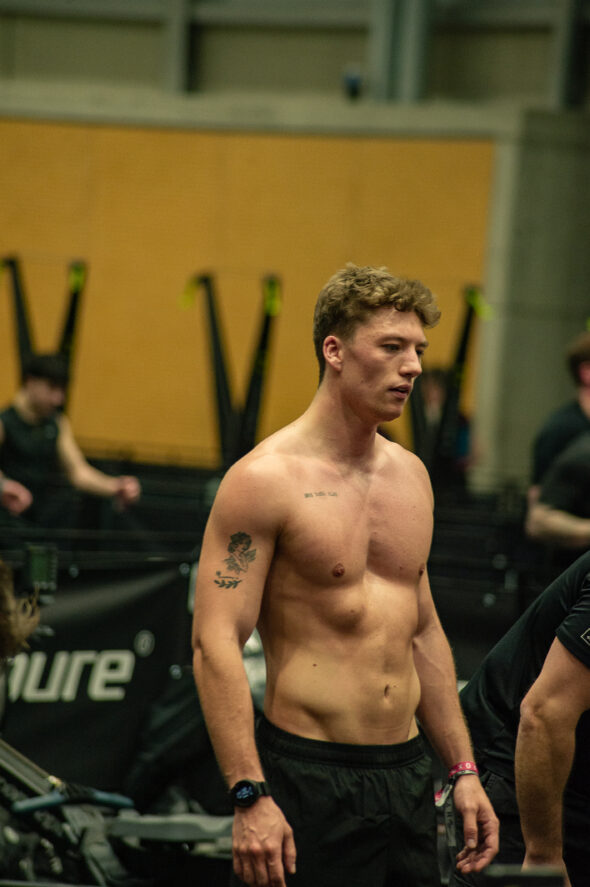
The athlete struggles against himself, but it is very difficult to make the viewer empathise with him or arouse emotion (which is why sports broadcasts are often so boring and why they depend so much on the emotion injected by the commentator).
Riefenstahl’s solution, which even today is the ABC of anyone who wants to photograph sports, is based on two points:
-First, the aesthetic beauty of the body in motion. A body that plays sports is a cultivated, harmonious body that is pleasing to look at.
-On the other hand, the search for elements of expression: extreme close-ups, unusual camera angles, etc.

Yesterday I was photographing a sports competition and, every so often, I remembered Leni Riefenstahl’s lessons. Faced with each subject, I wondered how to “optimise” what I was seeing and which, by definition, because it was happening in real time and was completely beyond my control, was impossible to “compose” as I do in the studio.
The only possibility was to look for compositions in the camera, moving myself.
It had been a long time since I had photographed so many people in such a mobile environment. Although it may seem otherwise, it is above all a mental exercise, because concentration and speed are paramount.
All photos were taken with a Nikkor 70-300 mm lens.